"I'm just..." Two words that can unintentionally minimize the impact of our work. In this blog post, Dr. Alicia Bates challenges Campus Activities professionals to stop downplaying their contributions and start owning the value their role brings to their institutions and the student engagement ecosystem.
Student leaders are often the most powerful messengers when it comes to the impact of campus activities. NACA Live is one place where you can strengthen your voice and bring that impact back to your campus.
Meghan Grace, Dawn Wiese, & William Foran examine how undergraduate men, particularly in fraternities, understand and engage in peer accountability, revealing greater confidence and participation among fraternity members compared to their unaffiliated peers.
Jean Patterson & Chelsea Redger-Marquardt’s qualitative study uses sensemaking theory to evaluate how students leaders and staff coordinators make meaning of their roles in a Living Learning Community (LLC).
Gyasmine George-Williams led a team from Cal Poly Pomona to explore the impact of the Activism Growth Model (AGM) on student learning and identity development across interdisciplinary courses, highlighting how students apply self-awareness, community connection, and social justice advocacy to their academic and personal lives.
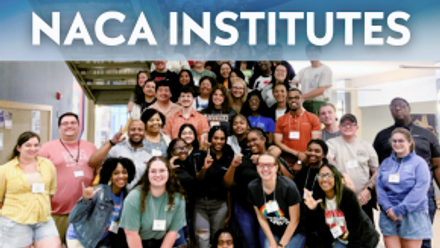
This summer 2025, NACA will once again offer four Institutes – two Programming Board Institutes and two Student Government Institutes. Learn more about these opportunities.
Read the latest in Campus Activities research on student engagement, involvement, and development amongst students in residence hall councils, Black men at PWIs, students of color employed on-campus, and Arab American students.
In this study by Sounny-Slitine on Arab American college students, participants discussed how they understand their Arab American identity and how they belong at their institution, as well as how engagement in student organizations and other means of student involvement impacted their experience with sense of belonging.
In this qualitative study, Pierre and Dunn explored how participating in a residence hall council impacted students’ conceptualization of leadership and their individual leadership development.